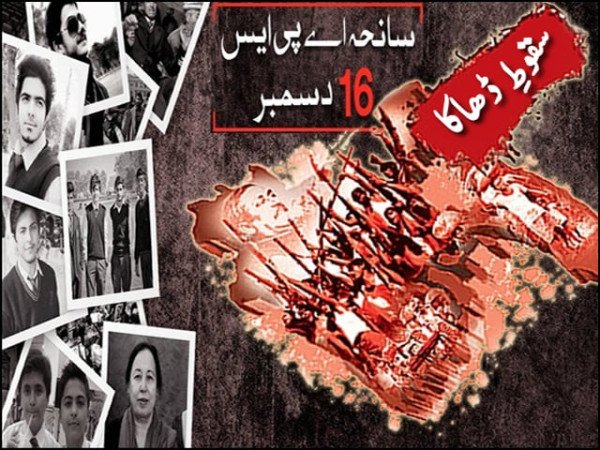
Since its inception, the country has faced repeated crises and calamities. Rarely has Pakistan experienced prolonged periods of peace; instead, the pages of history are filled with accounts of turmoil, insecurity, anarchy, and immense public sacrifice. December 16 carries the memory of two such tragedies. Although these events are separated by decades, each carries within it a tale of pain, sorrow, and bloodshed.
Whether it is the fall of Dhaka on December 16, 1971, or the Army Public School (APS) Peshawar tragedy on December 16, 2014, the arrival of December revives discussion of these events across electronic and print media. With the rise of social media, even dormant intellectuals awaken, expressing their views in various ways on the separation of the country and the martyrdom of innocent APS children, thereby refreshing memories of tragedies that should never be forgotten.
Yet, we display a troubling insensitivity. Despite claiming these tragedies are unforgettable, we consciously push them aside and repeatedly fail to learn any lessons from them. Their horrifying stories can never truly fade, but we forget—only to rediscover sudden waves of patriotism during these specific days in December. More alarming is the behavior of those who, even in their writings and discussions, fail to restrain their disruptive thinking. At times, blame is placed squarely on the government and state institutions; at others, our own shortcomings are mentioned so lightly as if these were minor mistakes rather than catastrophic national disasters that should simply be ignored and moved past. How can hearts become so hardened?
When the conspiracies and schemes of enemies and adversaries are mentioned, they are often discussed vaguely, as though they were not the driving forces behind these tragedies and that we alone were responsible. Some even go as far as predicting the recurrence of such disasters, claiming our direction has not changed and that we have learned nothing from past mistakes.
Yes, it must be acknowledged that our own errors and shortcomings played a role, and that we failed to fully learn from them. But does this justify promoting narratives against our own government, institutions, and country? Does shaping public opinion against national institutions not amount to yet another mistake—one we continue to repeat?
The pain of losing a part of the country in 1971 is as profound as the grief of a mother who lost her child in 2014. Such losses cannot be undone. Time may heal wounds and lessen the intensity of pain, but what has been lost can never be recovered.
Today, whether one turns to newspapers, television channels, or social media platforms, repeated references to the fall of Dhaka and the APS tragedy are unavoidable. The details are already etched into public memory, so there is no need to repeat them here. However, the anti-national content that surfaces in many articles and social media posts is deeply concerning. We accept that injustices and mistakes occurred in East Pakistan before 1971, but it was our enemies who exploited and fueled those issues.
The factors that led to the country’s dismemberment must not be ignored. Advising against repeating past mistakes is necessary, but institutions should not be branded as criminals. Criticism is a right, but it should not strengthen the hands of enemies. This hostile attitude toward our own institutions is, in itself, “another tragedy” that the nation continues to endure.