Monday 12 Oct, 2026

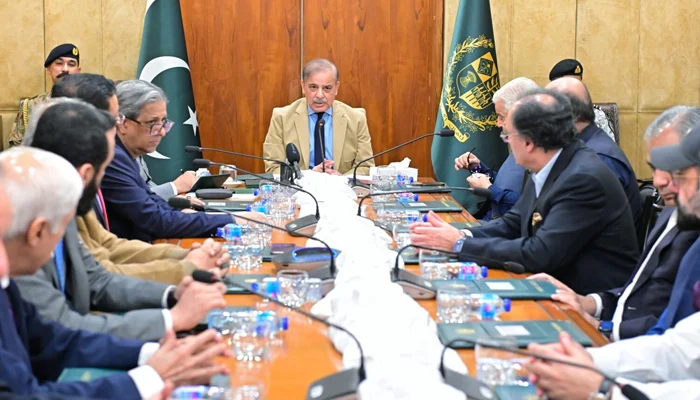
Metro53 - ISLAMABAD (Web Desk): The federal cabinet, chaired by Prime Minister Shehbaz Sharif, has reportedly decided to impose an emergency and Governor’s Rule in Khyber Pakhtunkhwa under Articles 232 and 234 of the Constitution, according to sources.
During the meeting, a proposal was presented to impose an emergency across the province under Article 232 in view of the deteriorating security situation. Sources said the administrative arrangements for 12 districts affected by unrest would be considered separately.
According to the sources, the federal government is also considering taking control of eight districts in the former Federally Administered Tribal Areas (FATA), along with Dera Ismail Khan, Lakki Marwat, Karak and Kohat.
The sources further claimed that Governor Faisal Karim Kundi would be entrusted with the powers of the province’s chief executive. Following formal approval by the federal cabinet, the governor would assume control of the provincial administration.
According to sources, two special security reports prepared by the Khyber Pakhtunkhwa Police and intelligence agencies were presented at the meeting.
The reports highlighted an increase in terrorist attacks across Khyber Pakhtunkhwa over the past two years, describing the growing threat as a serious challenge to the province’s security.
An intelligence report reportedly criticised the provincial government’s policy towards terrorist elements and their facilitators operating in Afghanistan, claiming that shortcomings in the policy and an alleged lenient approach towards militants had contributed to rising security risks.
The report also pointed to gaps in preparedness, attention and effective counterterrorism measures, which it said had allowed terrorist elements to expand their activities.
According to the report, terrorist incidents in Khyber Pakhtunkhwa increased by 195 per cent between March 1, 2024, and September 23, 2026.
The report identified links between terrorist networks, facilitators and illegal activities as another major security challenge.
It stated that police and security personnel were targeted in 73 per cent of terrorist attacks recorded in the province during 2026.
The use of drones by terrorist groups was also highlighted as a growing concern. According to the report, no drone attacks targeting police and security forces were recorded in 2024, while the number of such attacks reportedly reached 170 in 2026.
The report further claimed that drone attacks by terrorist groups had increased by approximately 107 per cent over one year.
The report also highlighted the increasing use of improvised explosive devices (IEDs). The number of IED attacks reportedly rose to 181 in 2025, while 159 incidents had been recorded by September 2026.
It stressed the need to enhance the operational capacity of the police and other law-enforcement agencies to counter evolving terrorist tactics.
The report also noted that the Safe City project, intended to strengthen surveillance and security infrastructure, remained limited to Peshawar, despite the security challenges facing the wider province.
Note: The reported cabinet decision, proposed administrative arrangements and security statistics have been attributed to unnamed sources and reports. Independent confirmation of the formal approval and implementation of emergency measures and Governor’s Rule was not provided in the supplied information.